The current frontier
What can we deliver with the means available now?
Existing tools, knowledge, capacity, rights and funding determine the currently feasible outcomes.
🏗️♾️ Transformational Intelligence ∞ ✨
How Intelligence Learns to Create What Makes New Possibilities Real
Build an ability worth having. Then test whether the experience makes you better at building a different one.
Versioned continuation · Public-image microscopy · Reproducible comparison
“When we build something new, we change what can be built next.”
Preserved first edition →Full paper and editable sources: https://montrealai.github.io/AGI-Alpha-Invention-Flywheel-Lab/learning-to-build-v1.1.0.html
A valuable outcome may be out of reach because its necessary means do not yet exist together. A new instrument might need a measurement method. A working prototype might need a reliable process. A useful service might need an arrangement that people can willingly support.
Learning to build means learning to find and construct that missing combination. The result is tested against the purpose it was meant to serve. What survives—an instrument, a method, an applicable lesson, productive capacity or available surplus—can help make a different construction possible.
The deeper question is whether experience improves the ability to construct the next set of means.
Build what makes the next breakthrough buildable.
The proposed contribution is a connection between representation and evaluation. A construction witness links an executable policy to its dependencies, resource schedule, authority, evidence and continuing obligations. It makes the route from a changed idea to an accepted ability inspectable.
The evaluation then asks a harder question: with the same legitimate knowledge, tools and resources, does an experience-revised construction procedure build a different accepted capability better?
Systems integration, program learning and economic complementarity are established fields. This work builds on them. It contributes an operational synthesis, elementary conditional results, and executable comparisons that keep useful artifacts, successor acceptance and constructor improvement distinct.
Complete bioimage-agent evaluation also has precedents, including BIABench. This continuation makes a narrower comparison within a supplied recipe bank and separately tests a strong specialist. It makes no claim of a new general benchmark or superiority over those systems.
Completeness is relative to a particular purpose and its conditions. The necessary pieces must work together well enough to deliver the accepted outcome.
What must be understood, measured or learned?
What tools or interfaces make the work possible?
How are the pieces constructed, tested and operated?
What capacity, time, materials and funding are available?
Who participates, under which rights, incentives and commitments?
The completion test Can these means jointly deliver the required result, under the actual constraints, with evidence that the result was accepted?
Separate the valuable purpose from inherited methods. Search for a different route, representation or cooperative arrangement.
Construct the missing pieces and their connections. Count the complete work, verify the dependencies and test the delivered result.
Retain what transfers, including useful failures. Test whether it improves fresh construction against capable alternatives.
The return path matters: each verified construction can change the starting conditions of the next. Continued improvement must be demonstrated on new work.
What can we deliver with the means available now?
Existing tools, knowledge, capacity, rights and funding determine the currently feasible outcomes.
What could become deliverable if we built the missing means?
A feasible construction path can change what is subsequently possible. Its costs, prerequisites and transition conditions belong in the comparison.
Expansion is conditional. Maintenance, obsolete methods, depleted resources or new obligations can also make the feasible set smaller.
A larger collection of tools can be valuable. Stronger claims ask whether the system can build a different tool—and whether experience makes that construction process better.
An existing instrument or method helps with a new accepted task.
Test: Does fresh use remain valid after qualification, adaptation and maintenance costs?
Available means support the construction of a different working capability.
Test: Is there an executable new artifact and an accepted result under the new task’s conditions?
Experience improves the procedure that finds and constructs useful means.
Test: Does it outperform strong controls on fresh tasks with matched information and complete resources?
The practical construction turns public microscope images into inspectable instance masks, counts and pixel-area records. A different successor asks for cell-body boundaries from DNA and actin.
0.949 test instance F1
SOURCE QUALIFIEDThe fixed CellposeDINO route passes all three gates on both official 50-field cohorts. This qualifies the recorded computational research use; it does not establish external laboratory acceptance.
0.506 test boundary F1
REQUIRED ≥ 0.60The specialist fails the boundary gate on calibration and test, despite meeting foreground and count gates. The selected classical route also fails, with test boundary F1 of 0.310.
24 / 24 recipes
OBSERVED TIEEvery classical arm exhausts the bank. Greedy coverage and ordinary empirical ranking select the same unqualified instrument. No accepted construction-method advantage is established.
Field means, rounded to six decimals. Nucleus rows use instance F1; cell rows use internal-boundary F1. Qualification requires both relevant cohorts.
| Specialist / cohort | Fields | Primary F1 | Foreground Dice | Count error | Verdict |
|---|---|---|---|---|---|
| Nuclei · validation | 50 | 0.953878 instance | 0.967388 | 0.066573 | All source gates pass |
| Nuclei · test | 50 | 0.949103 instance | 0.967232 | 0.070837 | All source gates pass |
| Cells · calibration | 4 | 0.386561 boundary | 0.860566 | 0.130928 | Boundary gate fails |
| Cells · test | 12 | 0.505568 boundary | 0.886682 | 0.200904 | Boundary gate fails |
The useful source route integrates an existing specialist. Its pretrained competence was not learned by the local constructor. The specialist was selected after classical source outcomes and registered before its own inference. Possible pretraining overlap with these public images is unknown; this reproduction does not establish unseen-data generalization.
Source recipe r17 passes the test cohort but misses the validation count-error limit of 0.20, so its complete source contract fails. All six successor arms select r12 and fail the boundary gate on both cohorts.
Classical reproduction under the same source and successor acceptance contracts. The source and successor use different primary F1 metrics.
| Instrument / cohort | Fields | Primary F1 | Foreground Dice | Count error | Verdict |
|---|---|---|---|---|---|
| Nuclei · validation | 50 | 0.884357 instance | 0.910637 | 0.216173 | Count gate fails |
| Nuclei · test | 50 | 0.897397 instance | 0.931317 | 0.088311 | Cohort gates pass |
| Cells · calibration | 4 | 0.250398 boundary | 0.850357 | 0.086298 | Boundary gate fails |
| Cells · test | 12 | 0.309897 boundary | 0.861007 | 0.104715 | Boundary gate fails |
All 16 successor fields have reference internal boundaries. The specialist has higher test boundary F1 than the classical recipe, but also higher count error; neither qualifies. The six-arm tie concerns selected instrument, quality and candidate count, while measured runtimes can differ. It does not establish statistical equivalence across independent construction tasks.
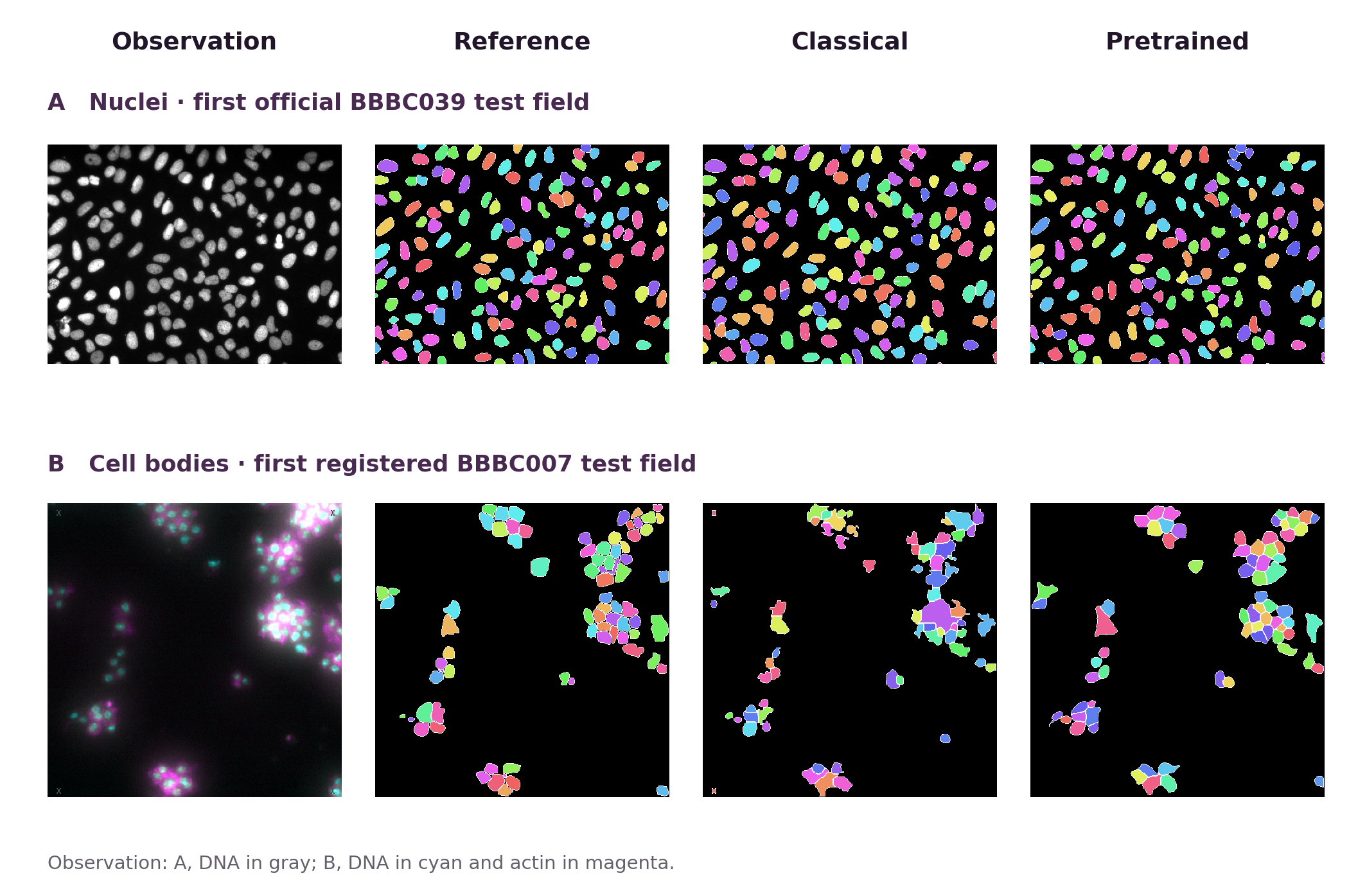
Read the evidence at its actual scope. This execution reproduces an already exposed registered comparison. It is not a new blinded confirmation. Acceptance thresholds are author-defined research gates. No laboratory acceptance, clinical use, commercial demand or earned funding is established.
All six classical builders receive the same 24 recipes, target channels, calibration references and permitted environment. They can all search the complete bank. The proposed update changes candidate order using donor experience; it does not discover new segmentation operators.
The six policies used four distinct orders. A separately frozen cached-score replay tested 33 order/settings interventions (30 unique orders): all exhausted the same 24 failing candidates and selected r12. This explains convergence through the shared recipe bank and fallback rule; it is not agreement among independently prompted models or fresh image inference.
The primary contrast is a supplied greedy-coverage order versus conventional empirical ranking from the same donor table. A local advantage requires an accepted successor and fewer candidate executions without losing acceptance. Full enumeration is a complete conventional control. The CellposeDINO specialist brings additional pretrained stock and is assessed separately.
Each arm is executed separately; target scores are not shared.
| Arm | What carries forward |
|---|---|
| Fixed, no history | Frozen expert-informed order |
| Ordinary reuse | Donor recipe first, then the fixed order |
| Updated, no artifact | Donor-derived greedy coverage; no privileged donor placement |
| Updated with artifact | Donor recipe first, then the greedy order |
| Same-content empirical | Ordinary ranking over the identical donor table |
| Full enumeration | All 24 recipes; the same calibration selection rule |
The first instrument must meet instance F1, foreground Dice and count-error gates on both the official 50-field validation and 50-field test sets. The successor must also recover internal boundaries, with F1 of at least 0.60 both across all fields and across fields containing true internal boundaries, on calibration and test separately.
High foreground overlap or an adequate count cannot replace the missing boundaries between cells. Area values are segmentation-derived pixel estimates; these gates do not establish biological area accuracy or physical units.
Applying the unchanged nucleus artifact to the successor gives boundary F1 0.072995. Supplying manual nuclei and foreground to the selected cell recipe gives boundary F1 0.671256, Dice 0.999933 and count error 0.159935 on the twelve test fields.
The latter uses privileged reference-derived inputs and is not a qualified raw-channel instrument. A follow-up fixed-r12 diagnostic separated the branches on only the four already exposed calibration fields. Raw inputs gave boundary F1 0.250398; reference nuclei alone gave 0.195353; reference foreground alone gave 0.615828; both reference inputs gave 0.714909. Separate scoring implementations agreed on every component mask. The seed branch also contributes to foreground, so these are software-branch interventions, not isolated biological causal effects.
Foreground recovery was the better next lead. One separately frozen ordinary composition used the specialist’s actual retained mask union as foreground for the original watershed. It reached boundary F1 0.296809, below the required 0.60 and below the unchanged specialist’s calibration score. The stop rule halted it with zero test fields scored, no tuning and no new neural inference. The failure is retained; an unexecuted complete raw-input command is not claimed as a demonstrated capability.
Inspect the frozen diagnostics · Inspect the failed practical composition. All cases remain exposed, and reference-assisted passes do not establish a deployable raw-input solution.
The original BBBC007 boundary benchmark permits manual inputs and reports a different proximity measure. Its historical percentage is not directly comparable to this raw-input symmetric F1.
The completed classical phases record 696.935 CPU seconds and 696.703 wall seconds, including donor construction and the labelled diagnostics. The completed 116-field specialist session records 4,969.507 CPU seconds and 4,970.035 wall seconds. These stage or session measurements exclude dependency setup, acquisition, independent verification, authoring, upstream pretraining, unavailable historical costs and economic costs. The classical ledger records no interrupted attempt, but the origin of 138 residual files remains unknown. Byte identity cannot distinguish copying from additional execution; any associated unrecorded work and cost remain unknown.
The reported local reproduction uses a dedicated Python 3.12.14 virtual environment with registered package versions and source hashes checked. It enables --system-site-packages, so it is not fully isolated and does not freeze every transitive binary or host component. The default isolated installer was checked separately; it did not replace the environment that produced these results. Setup receipts preserve the actual configurations.
The published history records a Boolean-outline decoding failure and a scalar/RGB observation mismatch. Narrow, versioned amendments repaired the interfaces before target test prediction or scoring. The shared RGB-to-L convention is generally lossy; it does not recover physical fluorescence.
The source and compact preregistration records were preserved. The original final raw-output package was not available for byte verification, so this edition uses new execution outputs. Historical costs that cannot be recovered remain unknown. The reproduction does not convert the exposed comparison into fresh hidden evidence.
The raw classical tree contained 416 files and failed the strict file-set check because 138 residual attempt-file copies remained alongside 278 canonical files. Every residual matched its canonical counterpart byte for byte; the cause is unknown.
The publication projection retains the 278 canonical files unchanged. All residual files and the reconstruction mapping are also retained, with no changes to reported metrics or costs. The manuscript appendix and construction guide explain the rejected raw tree and the separate checked projection.
Four programs generated from supplied arithmetic specifications pass 4,000 finite input checks. Across 288 authored resource conditions, the conventional equal-content planner ties every corresponding constructor-state decision. Retention can expand or contract attainable delivery once maintenance is charged.
Those are exact results in an authored finite model, not empirical success probabilities or evidence of learned-constructor superiority. Read the unchanged first edition →
Choose the entry that matches your purpose. The source package includes the manuscript, the preserved finite study, construction protocols, operation instructions, compact reproducible evidence and checks.
Start with the one-minute overview and the precise contribution. The microscope example shows why useful construction and improved construction methods need separate evidence.
Read the full manuscript →Open the practical brief →Follow the pinned setup, verify public input hashes, reproduce the comparison, or run an image through the emitted instrument. Inspect masks and measurements alongside the acceptance report.
Setup and operation guide →Download source and evidence ↓Contribute a clear measurement requirement, an authorized reference cohort, an independent check, or a stronger complete alternative. State what result would resolve the missing means.
Read the research programme →Discuss a reproducible finding →After the downloaded-release reproduction and raw-image operation pass, the release receives an operation receipt. It records operation of the released package; scientific qualification remains a separate verdict.
A quick start after extracting the source package: run python3 -B study/check.py to check the preserved finite study. The microscopy guide explains the additional scientific dependencies, public inputs and specialist setup; it also distinguishes rechecking retained outputs from performing new inference.
The next research target is a qualified successor with a demonstrated contribution from retained means. A better ordering of an exhausted candidate bank cannot supply a missing boundary-recovery method. Reliable seed and foreground construction, a new representation or a different boundary method each needs a separately registered comparison on a new confirmation cohort.
The long-term ambition is an intelligence-enabled enterprise whose useful work improves both what it can produce and how it discovers the next consequential construction.
Progress toward large physical systems still requires energy, materials, throughput, reliability, voluntary cooperation and time. Financial value, usable cash, installed capacity and human benefit must each be established.
This paper joins purpose-preserving transformation, viable productive arrangements and cumulative discovery around the construction of complete means.
Learning to change the game: examine the formulation and construct a better route to the authorized purpose.
Read the foundation →Discover productive capabilities and voluntary arrangements together, including complete costs and outside options.
Read the foundation →Couple frontier knowledge, useful construction and qualified successor benefit while keeping the claims distinct.
Read the flagship →Une possibilité utile peut rester inaccessible parce que les moyens nécessaires n’existent pas encore ensemble. Apprendre à construire, c’est apprendre à découvrir et à créer cette combinaison : connaissances, instruments, processus, ressources et arrangements entre participants volontaires.
Changer la donne → construire les moyens nécessaires → apprendre à mieux construire. Chaque construction doit répondre à sa finalité et faire l’objet d’une vérification. Les moyens conservés peuvent ensuite faciliter une autre construction. Réutiliser un outil, produire une nouvelle capacité et améliorer le constructeur constituent trois résultats distincts.
La version 1.1.0 conserve la première édition et ajoute une construction de recherche en microscopie : mesurer les noyaux, puis tenter une mesure différente des cellules entières. Le résultat utile, la qualification du successeur et l’avantage éventuel de la méthode de construction sont évalués séparément. La nouvelle exécution reproduit une comparaison déjà exposée; elle ne constitue pas une nouvelle confirmation à l’aveugle.
La méthode préentraînée satisfait les critères de recherche pour les noyaux sur les deux ensembles officiels. Son successeur pour les cellules entières échoue au critère de frontière. Les six stratégies classiques explorent toutes les recettes et aboutissent au même instrument non qualifié : aucun avantage de la méthode de construction n’est établi.
Les seuils sont des critères de recherche définis par les auteurs. Ils ne démontrent ni validation externe en laboratoire, ni découverte autonome, ni revenus réels, ni déploiement physique.
Quand nous construisons quelque chose de nouveau, nous changeons ce qu’il devient possible de construire ensuite.
Lire l’article intégral en anglais · Télécharger les sources et les éléments probants
English manuscript · Research edition 1.1.0 · Editable LaTeX and executable companion included.
The package includes the editable manuscript, bibliography, build instructions, preserved finite companion, microscopy source, registered comparisons, compact evidence and review. External datasets and pretrained weights are acquired separately under their recorded terms.
127888a4586f33066608cf9408f692edb2d3b8ea4d1fb9d8dc9a63ccd9355754Boucher, Vincent. (2026). Learning to Build: How Intelligence Learns to Create What Makes New Possibilities Real. Research edition 1.1.0. MONTREAL.AI / QUEBEC.AI. https://montrealai.github.io/AGI-Alpha-Invention-Flywheel-Lab/learning-to-build-v1.1.0.htmlMachine-readable citation
Change the game. Build what the new game requires. Learn to build better.