See docs/DISCLAIMER_SNIPPET.md
🌌 Algorithms That Invent Algorithms —
AI‑GA Meta‑Evolution Demo

Current runnable path — 1.36.0
Mode: Research training. Evolves small networks in a curriculum environment.
Prerequisites: numpy, torch, gymnasium and pandas for actual training.
After installation:
python -m alpha_factory_v1.demos check aiga_meta_evolution
python -m alpha_factory_v1.demos run aiga_meta_evolution
Expected result: Champion genome and generation history; missing torch is explicitly reported as a stub.
Scope: Small research environment; optional bridge adapters are not proof of open-ended intelligence.
The catalog explains installation, stopping, backups and recovery. Browser charts for legacy demos are labeled sample replays. Original research narratives and advanced scripts below are preserved; they do not expand the tested scope stated here.
This repository is a conceptual research prototype. References to "AGI" and "superintelligence" describe aspirational goals and do not indicate the presence of a real general intelligence. Use at your own risk. Nothing herein constitutes financial advice. MontrealAI and the maintainers accept no liability for losses incurred from using this software.
Each demo package exposes its own __version__ constant. The value marks the revision of that demo only and does not reflect the overall Alpha‑Factory release version.
“Why hand‑craft intelligence when evolution can author it for you?” — Jeff Clune, AI‑GAs: AI‑Generating Algorithms (2019)

A single‑command, browser‑based showcase of Clune’s Three Pillars:
| Pillar | Demo realisation |
|---|---|
| Meta‑learning architectures | Genome encodes a typed list of hidden sizes & activation; mutates via neuro‑evolution |
| Meta‑learning the learning algorithms | Runtime flag flips between SGD and a fast Hebbian plasticity inner‑loop |
| Generating learning environments | CurriculumEnv self‑mutates → Line → Zig‑zag → Gap → Maze |
Within < 60 s you’ll watch neural nets rewrite their own blueprint while the world itself mutates to stay challenging.
📑 Table of contents — click to jump
- [🚀 Quick‑start (Docker)](#quickstart-docker) - [🎓 Run in Colab](#run-in-colab) - [🚀 Production deployment](#production-deployment) - [🔑 Online vs offline LLMs](#online-vs-offline-llms) - [🛠 Architecture deep‑dive](#architecture-deepdive) - [📈 Observability & metrics](#observability-metrics) - [🧪 Tests & CI](#tests-ci) - [☁️ Kubernetes deploy](#kubernetes-deploy) - [🛡 SOC‑2 & supply‑chain](#soc2-supplychain) - [🧩 Tinker guide](#tinker-guide) - [🆘 FAQ](#faq) - [🤝 Contributing](#contributing) - [⚖️ License & credits](#license-credits)🚀 Quick‑start (Docker)
git clone https://github.com/MontrealAI/AGI-Alpha-Agent-v0.git
cd AGI-Alpha-Agent-v0/alpha_factory_v1/demos/aiga_meta_evolution

# optional: --pull (signed image) --gpu (NVIDIA runtime)
./run_aiga_demo.sh
The service automatically resumes from the latest checkpoint if one exists, so you can stop and restart the container without losing progress.
| Endpoint | URL | Purpose |
|---|---|---|
| Gradio UI | http://localhost:7862 | Click Evolve 5 Generations |
| FastAPI docs | http://localhost:8000/docs | Programmatic control |
| Prometheus | http://localhost:8000/metrics | aiga_* gauges & counters |
🧊 Cold build ≈ 40 s (900 MB). Subsequent runs are instant (cache).
Minimal host reqs → Docker 24, ≥ 4 GB RAM, no GPU needed.
🚀 Quick‑start (Python)
Prefer running natively? The service also launches directly from the repository without Docker. This path is handy for quick experiments or when Docker is unavailable.
git clone https://github.com/MontrealAI/AGI-Alpha-Agent-v0.git
cd AGI-Alpha-Agent-v0
AUTO_INSTALL_MISSING=1 python check_env.py  # verify deps offline/online
pip install -r alpha_factory_v1/demos/aiga_meta_evolution/requirements.txt
python alpha_factory_v1/demos/aiga_meta_evolution/agent_aiga_entrypoint.py
# offline machines can supply predownloaded wheels:
#   WHEELHOUSE=/path/to/wheels AUTO_INSTALL_MISSING=1 python check_env.py
# optional cross‑platform launcher
python alpha_factory_v1/demos/aiga_meta_evolution/start_aiga_demo.py --help
# or via module entrypoint
python -m alpha_factory_v1.demos.aiga_meta_evolution --help
# skip dependency checks or optional gateways via env flags:
#   SKIP_DEPS_CHECK=1 ALPHA_FACTORY_ENABLE_ADK=0 \
#   python alpha_factory_v1/demos/aiga_meta_evolution/start_aiga_demo.py
Launch the Ollama Mixtral model in another terminal:
docker run -p 11434:11434 ollama/ollama:latest --models mixtral:instruct
If you bind the server to a custom host or port, set OLLAMA_BASE_URL so the
demo can reach it. Example:
docker run -p 12345:11434 ollama/ollama:latest --models mixtral:instruct
export OLLAMA_BASE_URL="http://localhost:12345"
Set OPENAI_API_KEY in your environment to enable cloud models. Without
it the demo falls back to the bundled offline mixtral model.
Required environment variables
| Variable | Purpose |
|---|---|
OPENAI_API_KEY |
Optional key for OpenAI models. When unset the notebook and demo use Mixtral via a local Ollama container. |
WHEELHOUSE |
Directory of wheels for offline installs. Set before running check_env.py --auto-install in air-gapped setups. |
Offline dependency setup
Follow these steps when working air‑gapped:
-
Build the wheelhouse once using the same Python version as your virtual environment:
bash mkdir -p /path/to/wheels pip wheel -r requirements.txt -w /path/to/wheels -
Reuse the wheelhouse whenever you install or check the environment:
bash
   WHEELHOUSE=/path/to/wheels AUTO_INSTALL_MISSING=1 \
     python ../../check_env.py --auto-install --wheelhouse "$WHEELHOUSE"
Always run the command above before executing pytest or any demo so all
optional dependencies are installed correctly. When running tests offline,
execute the same command first to ensure all extras install from your
wheelhouse.
See alpha_factory_v1/scripts/README.md for additional tips on creating and using a wheelhouse. Consult docs/OFFLINE_SETUP.md for a brief overview.
Installing the OpenAI Agents SDK
The meta-evolution service depends on the OpenAI Agents SDK (or the
newer agents package) for all LLM access, even when running offline.
The optional bridge described below merely exposes the same tools over the
OpenAI runtime.
Install from PyPI:
pip install -U openai-agents
Offline, point pip to your wheelhouse:
pip install --no-index --find-links /path/to/wheels openai-agents
Some distributions ship the dependency as agents. The demo automatically
detects both. If you encounter ModuleNotFoundError: openai_agents, ensure
the package is installed in the active virtual environment.
🤖 OpenAI Agents bridge
Expose the evolver to the OpenAI Agents SDK runtime:
python alpha_factory_v1/demos/aiga_meta_evolution/openai_agents_bridge.py
The runtime listens on port 5001 by default. Set AGENTS_RUNTIME_PORT
to change the port:
AGENTS_RUNTIME_PORT=6001 python openai_agents_bridge.py
Requires the openai-agents or agents package (already installed above).
If both are missing the script exits with an error.
The bridge registers an aiga_evolver agent exposing five tools:
evolve (run N generations), best_alpha (return the champion),
checkpoint (persist state), reset (fresh population), and
history (past fitness scores).
It works offline by routing to the local Mixtral server when no API key
is configured.
🛰️ Google ADK gateway
Set ALPHA_FACTORY_ENABLE_ADK=true to expose the same agent via a local
Google Agent Development Kit gateway:
ALPHA_FACTORY_ENABLE_ADK=true python openai_agents_bridge.py &
This publishes the tools over the A2A protocol so other agents can
orchestrate evolution remotely. Enable the gateway whenever you need to
federate multiple Alpha‑Factory instances or let external clients control
evolution. Set ALPHA_FACTORY_ENABLE_ADK=1 in config.env to auto-start the
gateway when running ./run_aiga_demo.sh.
Define ALPHA_FACTORY_ADK_TOKEN to require this token on every ADK request:
ALPHA_FACTORY_ENABLE_ADK=1
ALPHA_FACTORY_ADK_TOKEN="my_secret_token"
Interact with the running gateway using curl:
curl -X POST http://localhost:9000/v1/tasks \
     -H "x-alpha-factory-token: my_secret_token" \
     -H "Content-Type: application/json" \
     -d '{"agent": "aiga_evolver", "content": "evolve 1"}'
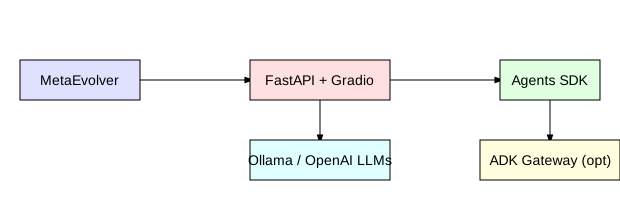
The optional ADK gateway integrates with the OpenAI Agents SDK bridge and underlying LLM providers as shown below.
🔐 API authentication
Export AUTH_BEARER_TOKEN to require a static token on every API request. For
JWT-based auth, provide JWT_PUBLIC_KEY (PEM) and optional JWT_ISSUER.
The /health and /metrics endpoints remain public.
🚀 Production deployment
For step-by-step instructions on running the service in a production or workshop environment, see PRODUCTION_GUIDE.md.
🎓 Run in Colab
|
Launches the same dashboard with an automatic public URL. Ideal for workshops & quick demos. |
The Colab notebook also explains how to upload a wheelhouse archive for offline installs. Follow that section to set WHEELHOUSE and run check_env.py --auto-install --wheelhouse when the runtime lacks internet access.
Supply OPENAI_API_KEY in the Colab session to access OpenAI models. When it is omitted, the notebook spins up an Ollama container and uses Mixtral as an offline fallback.
🔑 Online vs offline LLMs
| Environment variable | Effect |
|---|---|
OPENAI_API_KEY set |
Tools routed through OpenAI Agents SDK |
| unset / empty | Drops to Mixtral‑8x7B‑Instruct via local Ollama side‑car – zero network egress |
LLMs supply commentary & analysis only – core evolution is deterministic.
🔍 Alpha discovery stub
For a bite-size illustration of agent-driven opportunity scanning, run:
python alpha_factory_v1/demos/aiga_meta_evolution/alpha_opportunity_stub.py
To query a specific domain once without starting the full runtime:
python alpha_factory_v1/demos/aiga_meta_evolution/alpha_opportunity_stub.py \
  --domain supply-chain --once
The alpha_discovery agent exposes a single identify_alpha tool that asks the LLM to suggest three inefficiencies in a chosen domain. It works offline when OPENAI_API_KEY is unset.
♻️ Alpha conversion stub
Turn a discovered opportunity into a short execution plan:
python alpha_factory_v1/demos/aiga_meta_evolution/alpha_conversion_stub.py --alpha "Battery arbitrage"
The tool outputs a three‑step JSON plan and logs it to ~/.aiga/alpha_conversion_log.json by default. When OPENAI_API_KEY is configured, it queries an OpenAI model; otherwise a sample plan is returned.
🤝 End‑to‑end workflow
Combine discovery and conversion into a single agent:
python alpha_factory_v1/demos/aiga_meta_evolution/workflow_demo.py
The alpha_workflow agent lists opportunities in the chosen domain, selects the
first suggestion and returns a short execution plan. When Google ADK is enabled
(via ALPHA_FACTORY_ENABLE_ADK=1 and successful import of the ADK module), the same
agent is published over the A2A protocol for orchestration by external controllers.
🛠 Architecture deep‑dive
┌── docker‑compose ─────────────┐
│ orchestrator (FastAPI + UI) │◀─────────┐
│ ollama (Mixtral fallback)  │     │ WebSocket
│ prometheus (opt)       │     │
└───────────────────────────────┘     │
    ▲ REST / Ray RPC          │
┌────────────────────────────────────────┐ │
│ MetaEvolver    checkpoint.json  │ │
│  ├─ Ray / mp evaluation workers   │ │
│  └─ EvoNet(nn.Module) ──┐      │ │ obs/reward
│              ▼      │ │
│ CurriculumEnv (Gymnasium)       │◀┘
└────────────────────────────────────────┘
- MetaEvolver – pop 24, tournament‑k 3, elitism 2, novelty bonus toggle
- EvoNet – arbitrary hidden layers, activation ∈ {relu,tanh,sigmoid}, optional Hebbian ΔW
- CurriculumEnv – 12 × 12 grid, DFS solvability check, energy budget, genome auto‑mutation
📈 Observability & metrics
| Metric | Meaning |
|---|---|
aiga_avg_fitness |
Mean generation fitness |
aiga_best_fitness |
Elite fitness |
aiga_generations_total |
Counter |
aiga_curriculum_stage |
0–3 |
Enable profile telemetry to autopush → Prometheus → Grafana.
docker compose --profile telemetry up.
🧪 Tests & CI
- Coverage ≥ 90 % in < 0.5 s (
pytest -q) - GitHub Actions → lint → test → build → Cosign sign
- SBOM via Syft (SPDX v3) per release
☁️ Kubernetes deploy
apiVersion: apps/v1
kind: Deployment
metadata: { name: aiga-demo }
spec:
 replicas: 1
 selector: { matchLabels: { app: aiga-demo } }
 template:
  metadata: { labels: { app: aiga-demo } }
  spec:
   containers:
   - name: orchestrator
    image: ghcr.io/montrealai/alpha-aiga:latest@sha256:<signed>
    ports:
    - { containerPort: 8000 }  # API
    - { containerPort: 7862 }  # UI
    readinessProbe:
     httpGet: { path: /health, port: 8000 }
    envFrom: [{ secretRef: { name: aiga-secrets } }]
Helm chart → infra/helm/aiga-demo/.
🛡 SOC‑2 & supply‑chain
- Cosign‑signed images (
cosign verify …) - Runs non‑root UID 1001, read‑only code volume
- Secrets via K8s / Docker secrets (never baked into layers)
- Dependencies hashed (Poetry lock) & validated at runtime
- SBOM exported; SLSA level 2 pipeline
🧩 Tinker guide
| Goal | File | Hint |
|---|---|---|
| Bigger populations | meta_evolver.py → pop_size |
Add --profile gpu |
| Faster novelty | Genome.novelty_weight |
Try 0.2 |
| New curriculum stage | curriculum_env.py |
Extend _valid_layout |
| Swap LLM | config.env |
Any OpenAI model id |
| Automate experimentation | FastAPI → /evolve/{n} |
Deterministic SHA checkpoint id |
| Manual reset | FastAPI → POST /reset |
Fresh population |
| Persist progress | FastAPI → POST /checkpoint |
Atomic save |
🆘 FAQ
| Symptom | Fix |
|---|---|
| “Docker not installed” | https://docs.docker.com/get-docker |
| Port collision 7862 | Edit host port in compose |
| ARM Mac slow build | Enable Rosetta or ./run_aiga_demo.sh --pull |
| GPU unseen | sudo apt install nvidia-container-toolkit & restart Docker |
| Colab URL missing | Re‑run launch cell (ngrok quirk) |
⚖️ License & credits
Source & assets © 2025 Montreal.AI, released under the Apache‑2.0 License. Huge thanks to:
- Jeff Clune – visionary behind AI‑GAs
- OpenAI, Anthropic, Google – open‑sourcing crucial agent tooling
- OSS maintainers – you make this possible ♥
Alpha‑Factory — forging intelligence that invents intelligence.
Local conversion workflow
Run a bounded supplied-input workflow without an SDK, model download or server:
python -m alpha_factory_v1.demos.aiga_meta_evolution.workflow_demo --alpha "solar energy generation"
Conversion validates the description, classifies supported keyword families
(inventory, energy, finance, automation, or general), and produces corresponding
evidence and experiment steps. Output includes the normalized input hash,
local_rule_based_plan provenance and proposal_only status. This is a deterministic
rule-based planner, not AI inference, execution, or a feasibility guarantee.
convert_alpha retains its dictionary/steps interface and optional ledger argument.
OpenAI conversion requires ALPHA_CONVERSION_ALLOW_PROVIDER=1, a key and the modern
OpenAI().chat.completions.create SDK contract. Provider errors or invalid schemas
fail explicitly; no canned success is substituted. No provider was qualified here.
The optional historical SDK service is explicitly launched with --serve; its
module imports are package-relative. Discovery additionally requires
AIGA_ALLOW_DISCOVERY_PROVIDER=1, and missing inference adapters raise an error.
These changes do not qualify evolutionary training or claim seeded training reproducibility.